
Studio Technologies – Model 5412 Audio Interface


More details

Similar Products

peai9090a
  • Profitt

Profitt – PEAI-9090

The devices are designed for:

- connection of analog or digital audio signals in AES 3 format to the local audio transmission network ( AoIP ) using AES 67, Dante protocol ;

- connection of microphones to the local audio transmission network ( AoIP ) via AES 67, Dante protocol ;

- audio data exchange between Ethernet Dante , AES 67 and 3 G / HD / SD SDI digital video signals (devices with index ' V '); - creation of a distributed network of audio switches with a common switching field; - transfers

Ethernet ( AES 67, Dante ) over optical links;

- indication of audio signal levels ( PEAI -9090, PEAI -9091).

Ethernet Dante audio interfaces , AES 67 support:

- 8 in, 8 out ( PEAI -9088, PEAI -9090) and 16 in, 16 out ( PEAI -9091) balanced analog audio

or 4 in, 4 out ( PEAI -9088, PEAI -9090) and 8 in, 8 out ( PEAI -9091) AES 3 digital audio channels .

Devices with suffix ' V ' contain a 4-channel audio communication module between Ethernet Dante , AES 67 and 3G / HD / SD SDI digital video signals . The devices have an SDI input and two SDI outputs . Up to 16 audio channels of SDI embedded audio are supported .

Devices with suffix ' R ' contain an AES 3 digital audio input/output module with support for User Bits and Channel Bits (compatible with Riedel intercom equipment ).

The PEAI -9090 and PEAI -9091 devices can be equipped with submodules with microphone inputs (suffix ' M ' in code). This provides a voltage supply of '+48 V ' to the microphones and control of the gain of signals from the microphones.

The front panel of the PEAI -9090 and PEAI -9091 has a display that shows indicators for input and output signals.

The type of audio signals for inputs and outputs, independently of each other, is selected by the User (should be reflected in the device code).

The devices have two electrical Ethernet 100/1000 BaseT ports - primary ( Primary ) and backup ( Secondary ) and one optical (except for PEAI -9091). A redundant electrical Ethernet port provides connection to a redundant audio transmission network or device cascading. The presence of an optical transmission line through a separate SFP module allows you to transmit Ethernet ( AES 67, Dante ) over optical communication lines over long distances

( Ethernet SFP module not included in the device; see section 'SFP modules optical and electrical', section II , pos. 1.1:1.6).

Management and monitoring are carried out over the Ethernet network using the proprietary Dante Controller program and via the WEB interface.

Separate power inputs for main and backup power supply. 'Hot' replacement of power supplies.

Audio connectors DB 25 and RJ 45 (on module ' R ').

    I/O Interfaces
Core_X10
  • Q-SYS

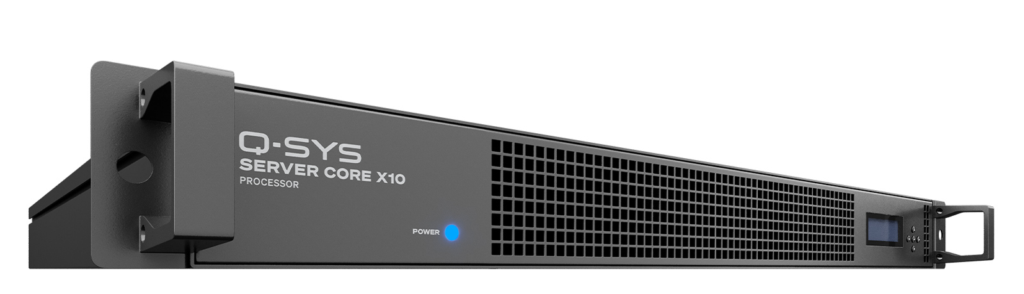
Server Core X10

Network I/O or paired with distributed processing. Features & Benefits
  • 256 x 256 networked audio channels (Q-LAN / AES67)
  • 64x AEC channels @ 200 ms
  • Includes 8 x 8 Software-based Dante channels (licensable up to 128 x 128)
  • Supports up to twelve (12) Q-SYS NM-T1 tabletop microphones
  • Up to 32 VoIP softphone instances
  • 64 x 64 Media/WAN channel capacity
  • 16 multitrack playback channels (up to 128 with optional stackable feature license)
  • 4 multitrack record channels
  • Two (2) 2.5 Gbps Ethernet ports for redundant networked audio
  • Two (2) 2.5 Gbps independent, auxiliary Ethernet ports for segregation of network services such as VoIP, SNMP, LLDP, LDAP and WAN Media streaming
  • Onboard 256 GB media drive
  • 1 RU form factor
    I/O Interfaces
  • Dante Ch: 8x8
  • 48kHz
DCS-100M侧面
  • BARE

BARE – DCS-100M

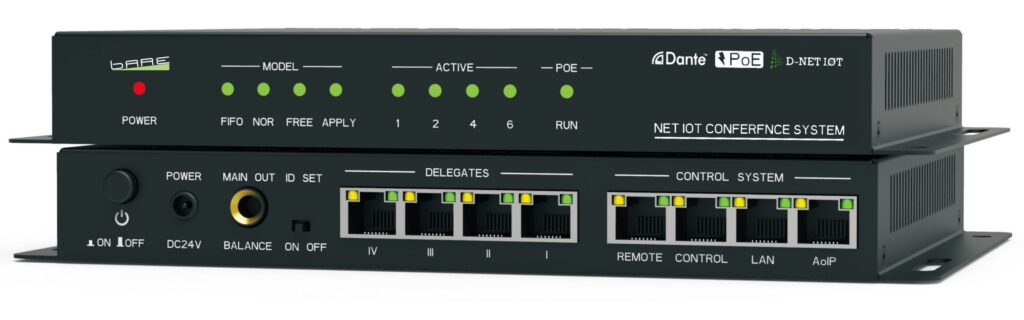
Features: 1. Original D-net IOT digital conference IoT system technology, in line with IEC60914 international standard 2. Support 41kHz/48kHz audio sampling rate, long-distance transmission will not have any impact on sound quality 3. The host computer and the computer can be connected through TC/IP or network access WiFi to realize wireless control mode, and the host can realize IP-based address allocation to realize distributed application management 4. D-net IOT technology can realize the flexible completion of networking or independent partitioning of multiple conference systems, and a variety of conference fields can be used for expansion 5. Dante network audio interface, support to match any Dante audio equipment, and realize computer host computer software control and I Pad software remote control to set various parameter values through the use of TCP/IP connection; 6. Support Ethernet (POE) power supply, digital signal, DSP control, one cable digital link system unit adopts loop loop connection (1 output, 1 backup input) to ensure that the system can be used efficiently and normally. The system is more reliable and supports line "hot plugging", and microphones can be added to the system at any time 7. With the camera tracking host, after using the computer preset, the camera can automatically track and support the preset panoramic position 8. With D-net IOT digital conference IOT system independently researched and developed to realize five kinds of directional adjustable modes of pickup microphone: omnidirectional, cardioid directional, super cardioid directional, sharp-heart directional, Figure- 8-pointing type; 9. The system host supports dual backup output of analog and digital signals, and supports dual backup power supply of POE power supply and external 24V module; 10. Optional external 3.5-inch wall control touch screen for conference host management and settings, convenient and efficient, and can display the following information at the same time: a. Time-limited mode: The speech time limit can be set to 1-60 minutes, and the speech will be automatically closed when the time is up. After reaching the power-on quantity, when another representative unit wants to speak, it will automatically enter the request-to-speak registration queue. b. First-in-first-out mode: First-in-first-out speaking mode (factory preset position), after reaching the number of power-on, the speaking unit opened first is closed by the subsequent speaking unit. c. Application for speaking mode: the speaking of the representative unit needs to be approved by the chairman unit or the operator. In this mode, the chairman unit always keeps the normally open state. d. First-in-first-out mode; you can choose 1/2/4/6 microphones to speak at the same time, and the chairman microphone and VIP microphone can be preset without restriction. e. Volume adjustment of main output 11. The system can be connected to PC control to realize centralized microphone management. Through software, microphone pickup gain adjustment, forced switch, speaker information registration, can initiate sign-in function, detect microphone line conditions, software set VIP unit, VIP unit The switch is not limited by the number of conference units that are open at the same time and the speaking mode
    I/O Interfaces