
BARE – BE-0812D


More details

Similar Products

2019726141959
  • BARE

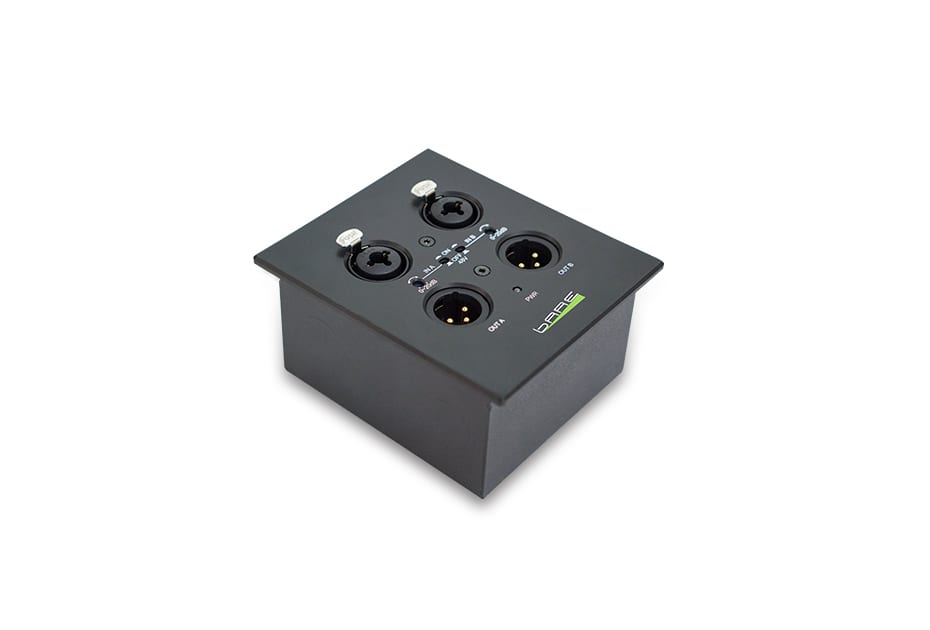
BARE – BOX 2x2IO

BOX 2 * 2 / IO is a powerful digital signal processor that does not require extensive learning. It provides 2 microphone / line inputs and 2 line outputs with phantom power. Embedded installation, with many high-quality features, no design, no learning at all. A complete audio processing solution for the optimization of specific locations and systems. Suitable for retrofitting Dante ™ audio applications and upgrading traditional audio systems.

    I/O Interfaces
ies-5400-front-top-angle
  • AtlasIED

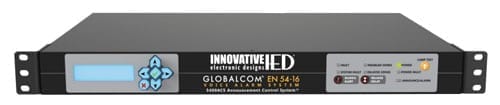
AtlasIED – IED5400ACS

The 5400ACS is an integrated announcement controller with built-in message server capability that is the core of an EN 54-16 compliance life/safety emergency notification system. These units contain all of the intelligence to manage an entire system of emergency communication stations, digital zone manager amplifier units, and other network peripherals. The 5400ACS manages the system in compliance with the EN 54-16 standard, performing overall supervision and reporting of equipment faults plus any ongoing alarm conditions.  The 5400ACS is capable of interfacing with GLOBALCOM 1100ACS/1200ACS units when additional non-emergency features or additional peripherals are required in an installation.Announcement Management Features
  • Can handle dynamic requests for live pages, delayed pages, Digital Record and Playback (DRP), prerecorded messages (simple and assembled), and mute actions.
  • Internal message server capable of recording 2 channels of delayed messages while providing 2 channels of message playback; all occur simultaneously in addition to as many live pages that can be supported by Dante on the network.
  • Manages disabled and delayed zones.
  • Network audio using Dante (High Quality Audio over Ethernet).
  • Announcements can be initiated by contact closures, from a microphone paging station, from the 5400ACS front panel, or by a network command from higher level management software such asAtlasIED Director.
  • Messages can be played based on schedules.
  • Fully monitors and supervises all components of the system.
  • Fully customizable and programmable via software tools.
Device Interface/Management Features
  • Provides 8 optically isolated logic inputs for external interfaces including supervision of logic links.
  • Provides 4 Form C relay outputs for external interfaces.
  • Multiple controllers can be used together to create larger systems.
  • Provides two analog audio inputs for such sources as background music or fire panel audio.
  • Provides two analog audio outputs for audio monitor or zone outputs.
  • Manages up to 50 digital microphone stations (5416CS H/G or 5450CS H/G Series) on one 5400ACS.
  • Supervises all associated devices and provides fault status information.
  • Overall Form C fault relay provided.
  • Works seamlessly withAtlasIED5400LL Lifeline Controllers providing hot-standby and individual fail-over support.
  • Interfacing DZMs can allow management for up to 1024 individual zones.(5404DZM/5432DZM).
  • Provides redundant ethernet ports.
Message Server Features
  • Stores up to 250 hours of pre-recorded .wav message files.
  • Delayed messages limited only by disk space.
  • Capable of 2 playback and 2 recording operations simultaneously.
    I/O Interfaces
yamaha-swr2100p_5g_1200px
  • Yamaha

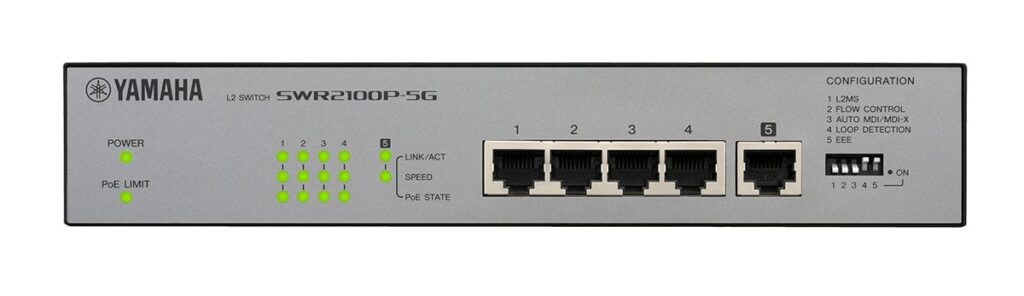
Yamaha – SWR2100P-5G

Complex network switch setup that was previously better left to an IT technician can now be easily accomplished by anyone. A simple switch setting is all it takes to optimize SWP1 series network switches for Dante operation, and a dedicated Windows application provides “network visibility” for comprehensive monitoring and control. Yamaha has used its knowledge of both IT and pro audio to provide "SWR2100P series" simple L2 switch that has been optimized for networked audio installations. The switch can take advantage of "Yamaha LAN Monitor" a dedicated Windows application that provides 'network visibility' for comprehensive monitoring and control. The "SWR2100P series” which are simple L2 switches can supply power as well as audio and control signals to a PoE-compliant Dante device such as the paging station microphone “PGM1” through just one Ethernet cable. Since the power supply and the network wiring can be combined, the number of cables being used can be reduced, and the connection distance can be extended, so the degree of freedom of Dante device installation is increased and construction flexibility is further improved. Systems built around the SWR2100P-5G or SWR2100P-10G L2 switches allow comprehensive network monitoring from the dedicated Yamaha LAN Monitor software application, with PoE power status monitoring and ON/OFF switching capability. Understanding how multiple switches installed in different locations are connected, plus how network devices are connected to those switches, can be a difficult, time-consuming task. The Yamaha LAN Monitor makes overall network topology clearly visible, giving the user a comprehensive overview of how multiple switches and Dante network devices are interconnected. Simply connect a Windows PC to the nearest SWR2100P series switch and launch the Yamaha LAN Monitor software. You can take a “snapshot” of the network status when set up as required. The software can then automatically keep track of the settings and alert you to any changes. You could take a snapshot of the network, and then you would be alerted if a cable is disconnected, if a device is turned off, or if a wrong connection is made prior to the performance, for example. Identifying devices connected to a switch by only their IP or MAC address is a difficult and error-prone approach. Connected Dante devices are identified by a Dante icon as well as a device ID previously set up via the Dante Controller software. You can also enter additional info, such as the location of the device, in the Label and Comment fields. If the monitoring device does not respond to a Ping, it judges that a fault has occurred and automatically stops the PoE power supply to that device and then resumes it. This restarts the monitoring equipment and attempts recovery. By collectively managing the status of the devices distributed over a wide area, it can ensure that equipment management can operate far more smoothly.
    I/O Interfaces